IoT Water Usage Monitoring System
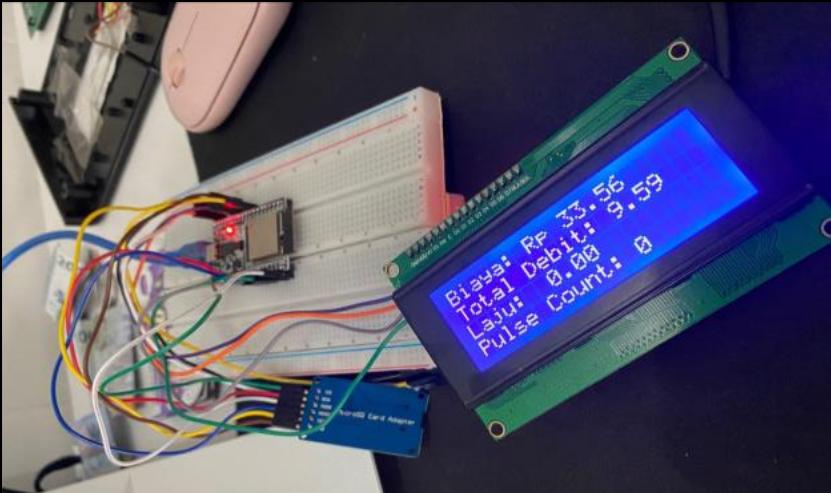
Created IoT system for real-time PDAM water consumption monitoring with automated cost calculation based on official tariff rates. ESP32 reads water flow sensor data, processes volume and cost calculations, and displays results on LCD while transmitting data to users via Telegram Bot and Blynk mobile app.
Technologies Used
Project Overview
This project develops an IoT-based PDAM water consumption monitoring system capable of calculating water usage and cost estimation in real-time. The system is designed to help users monitor monthly water usage transparently, increase consumption awareness, and encourage water conservation practices. By utilizing water flow sensors and ESP32 microcontroller, the system can measure water volume used, calculate costs based on PDAM tariff rules, and present data directly to users through various media.
System Architecture
ESP32: Used as main microcontroller for reading sensor data, processing calculations, and sending data in real-time.
Water Flow Sensor: Used to measure water flow rate and volume as basis for consumption calculation.
LCD 2004: Used to display water usage information and cost estimation directly on device.
Telegram Bot API: Used as remote notification and monitoring media easily accessible by users.
Blynk Platform: Used for real-time water consumption data visualization through mobile application.
Key Features
Real-Time Water Usage Monitoring: System measures water flow rate and volume used in real-time using water flow sensor for accurate consumption data.
Automated Cost Calculation: Water usage data is processed to calculate cost estimation automatically based on applicable PDAM tariff scheme.
Multi-Channel Data Visualization: Consumption and cost information displayed directly on LCD 2004 and sent to users via Telegram Bot and Blynk platform.
Remote Monitoring & Notification: Users can monitor water usage remotely through mobile application and receive data updates periodically.
Structured Development Approach: Project developed through structured stages from literature study, requirement analysis, system design, implementation, to evaluation.
Project Outcome
✓ Real-time water monitoring promoting consumption awareness and cost transparency